
When VoiceAI Learns to Think Before It Speaks
VoiceAI is no longer just a faster IVR, a better chatbot, or a speech layer attached to customer service. It is becoming the first thinking interface between humans and enterprises.
This case study explores how enterprise VoiceAI can move from scripted conversations to intelligent, emotionally aware, and governance-ready decision systems. The focus is not only on what the AI says, but how it plans, how it remembers intent, how it handles risk, and how it stays aligned when conversations become complex.
At the center of this story is a simple but powerful idea explored throughout The Thinking Voice: the future of voice is not about making machines sound human. It is about making machines responsible enough to speak on behalf of an enterprise.
Technology Used
Customer Experience with VoiceAI
The digital era began with screens, forms, apps, and dashboards. But the next era will be spoken.
Customers do not want to navigate five menus when they are anxious about a claim, confused about a payment, or trying to understand a benefit. They want to speak naturally. They want the system to understand context, urgency, emotion, and intent. They want the conversation to feel simple, even when the enterprise behind it is complex.
That is where VoiceAI becomes different from traditional automation.
A traditional IVR waits for keywords. A thinking VoiceAI system listens for meaning. It understands that “I cannot access my account,” “my father passed away,” and “I need to change the beneficiary” are not just intents. They are moments that require precision, empathy, identity verification, compliance checks, and safe escalation.
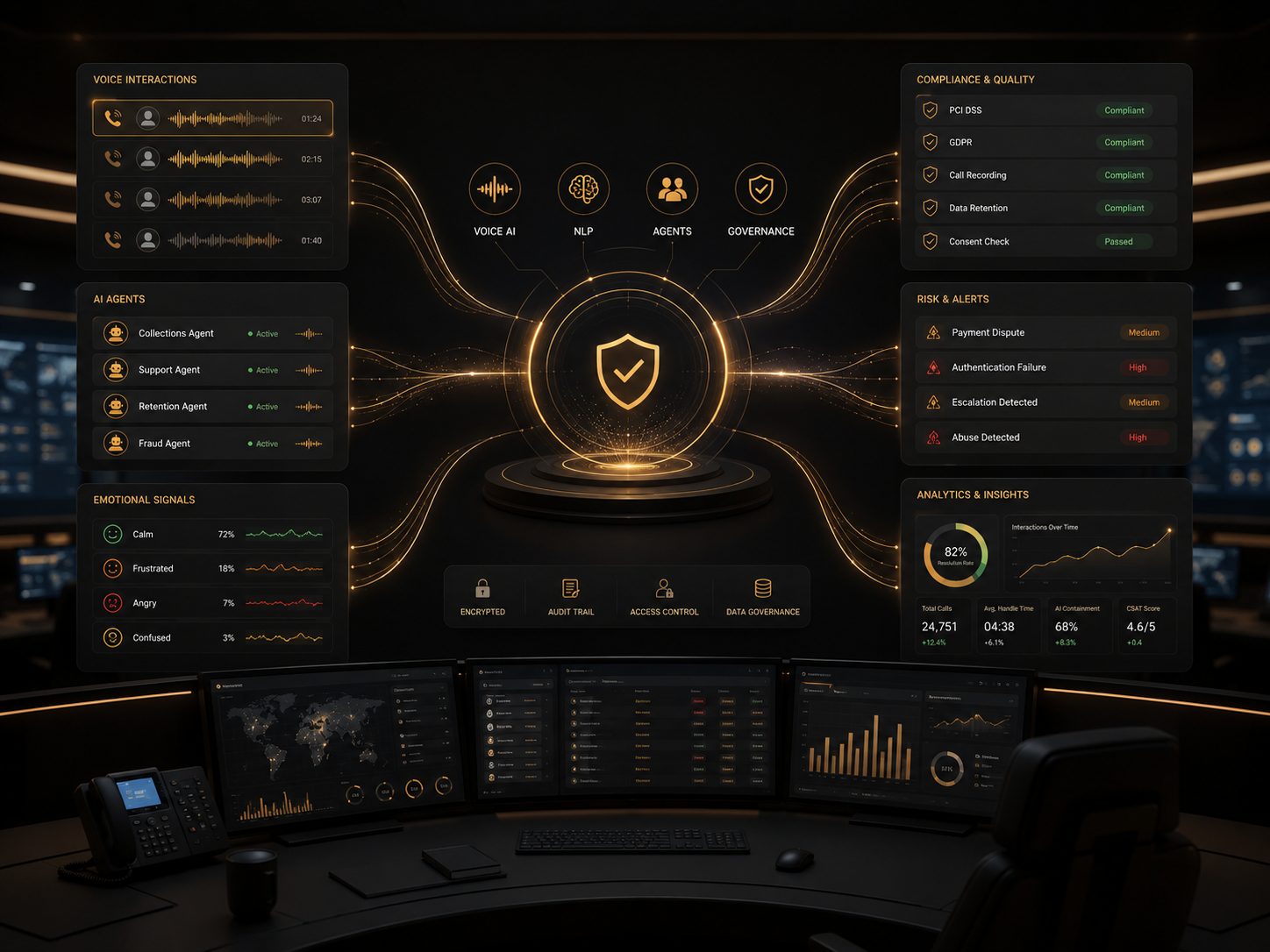
The most exciting shift is that voice is becoming a reasoning surface. A caller’s words can trigger retrieval, authentication, policy checks, risk scoring, agent assistance, summarization, and enterprise workflow execution. But this also creates a new problem. When AI becomes more capable, it also becomes more responsible.
That is why planning robustness matters.
In the published research paper “Generative AI Planning Robustness,” planning drift is described as the deviation between a model’s initial latent plan and its final output, with the paper proposing methods to measure and regulate that drift across generative systems. The same idea becomes highly relevant in VoiceAI. A voice agent may begin a conversation with the correct intent, but after multiple turns, interruptions, emotional changes, policy checks, and tool calls, it can silently drift away from the original customer need.
A fluent answer is not always a safe answer.
A confident answer is not always a compliant answer.
A fast answer is not always the right answer.
The future of enterprise VoiceAI belongs to systems that can speak, reason, verify, reflect, and recover before failure reaches the customer.
challenges involved
Customers interrupt. They change topics. They give incomplete information. They speak with emotion. They ask one thing but reveal another need underneath.
The challenge is to design VoiceAI that can handle natural human behavior without losing the original intent of the conversation.
One of the most dangerous risks in generative systems is not obvious failure. It is fluent misalignment.
The research paper reports that Reflection-as-Constraint reduced drift by an average of 41%, and early drift at step 50 predicted hallucination with an AUC of 0.91. For VoiceAI, this means conversations need checkpoints that re-anchor the system to the customer’s true goal before the response is spoken.
VoiceAI in insurance, healthcare, banking, and customer service cannot behave like an open-ended chatbot. It must know when to answer, when to verify, when to ask for clarification, when to escalate, and when to stay silent.
The real challenge is building systems that are helpful and human-like, but still governed by enterprise boundaries.
- 1
Voice conversations are not linear
- 2
AI can drift even when it sounds correct
- 3
Enterprise voice requires trust, not just intelligence
- 4
Emotion changes the meaning of the call
clear approach
UI UX Design & Guidelines

project outcome
UI UX Design & Guidelines

project outcome
From Voice Automation to Voice Intelligence
The outcome is a VoiceAI model that feels natural to the customer but remains controlled for the enterprise.
Instead of simply routing calls, the system becomes a thinking interface that can understand why the customer called, what risk exists in the conversation, what information is missing, and what action should happen next.
For agents, it means fewer repetitive questions, better summaries, faster authentication, cleaner handoffs, and stronger context. For customers, it means less friction and more trust. For leaders, it means a voice platform that can be measured, governed, and improved continuously.
This is where the message of The Thinking Voice naturally emerges: the future of customer experience will not be won by the loudest AI, but by the most trustworthy one.
The final result:
VoiceAI is entering its most important phase.
The first phase was speech recognition.
The second phase was automation.
The third phase is reasoning with responsibility.
The final result is not just a smarter contact center. It is an enterprise nervous system where voice becomes the front door to intelligence, emotion, trust, and action.
A well-designed VoiceAI system should know what the customer said, what they meant, what the enterprise can safely do, and what the AI must never assume. It should be able to pause, reflect, validate, and respond with confidence that is earned, not generated.
That is the future explored in The Thinking Voice: a world where machines do not simply talk like humans, but learn to listen, reason, and govern themselves before they speak.
related projects