Building the Future of VoiceAI for Human-Centered Enterprises
VoiceAI is becoming the new global interface between people and enterprises.
For years, organizations treated voice as a support channel. A customer called, a system routed, an agent answered, and the interaction ended. But the next generation of VoiceAI is different. It does not simply receive calls. It listens, reasons, verifies, adapts, and helps organizations respond with speed, empathy, and accountability.
This case study explores how a modern enterprise can transform voice from a reactive service layer into a governed intelligence layer. The goal is not just automation. The goal is to empower every customer conversation with better context, better trust, and better decisioning.
The idea connects directly with the central message of The Thinking Voice: the future of enterprise voice will not be defined by how human the AI sounds, but by how responsibly it thinks before it speaks.
Core VoiceAI Capabilities
When Voice Becomes the Front Door to Enterprise Intelligence
The digital era has always been about connection. Websites connected brands to customers. Mobile apps connected services to daily life. Cloud platforms connected data, operations, and scale.
Now, voice is becoming the next major connection layer.
A customer does not always know which department they need. They may not know the right form, the right policy, or the right technical phrase. They only know their problem. They speak naturally, sometimes with frustration, urgency, confusion, or emotion. A true VoiceAI platform must understand that human reality.
This is where global vision matters.
A modern enterprise cannot build VoiceAI as a small automation experiment hidden inside the contact center. It must be designed as an enterprise intelligence platform. Every call can become a signal. Every intent can become an insight. Every escalation can become a learning loop. Every compliance check can become a trust layer.
But the most powerful part is also the most invisible.
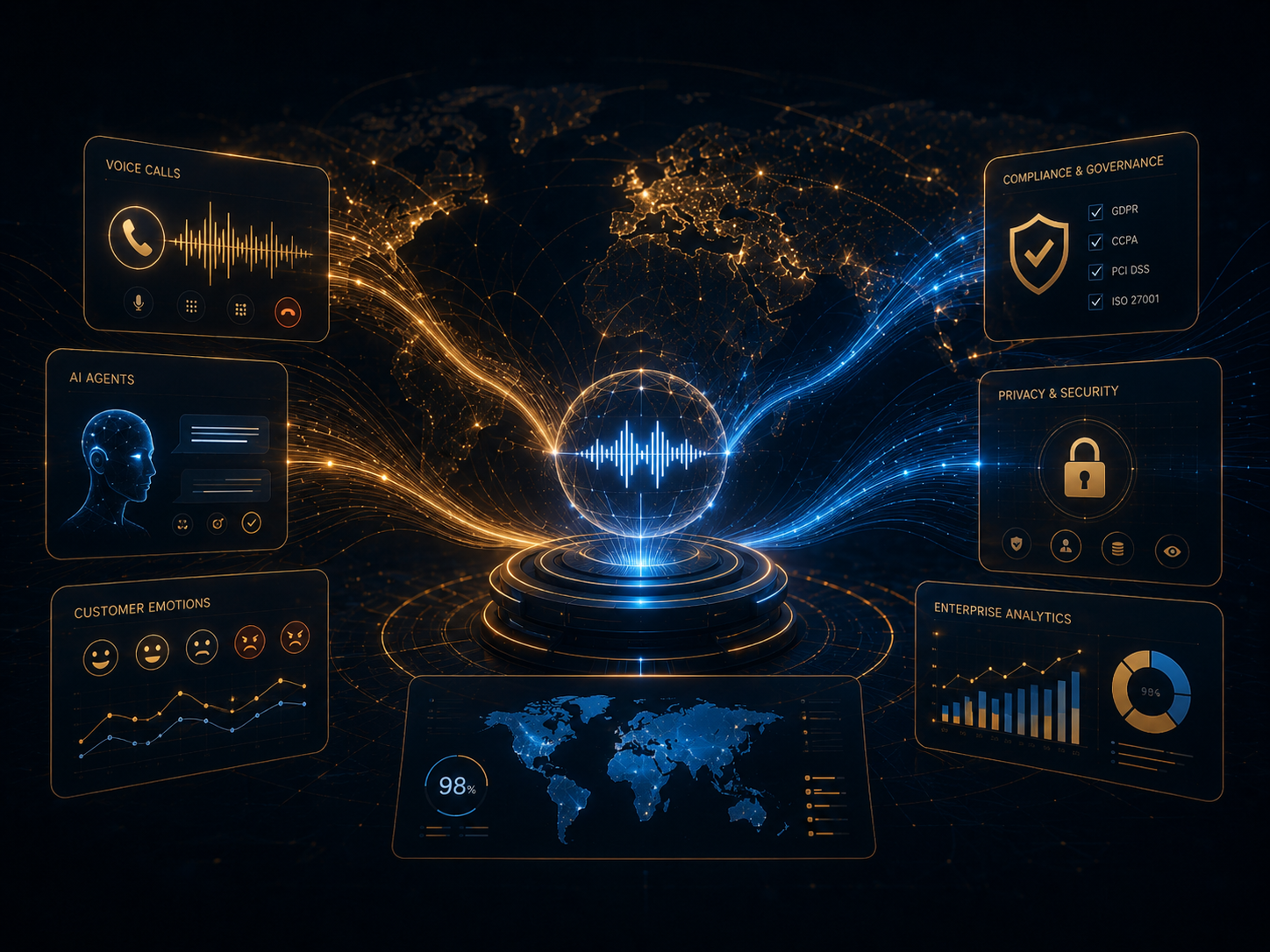
The best VoiceAI systems should not look complicated to the customer. They should feel simple. Behind that simplicity, the system may be authenticating identity, detecting risk, retrieving enterprise knowledge, checking policy boundaries, identifying emotional state, preparing agent assistance, and producing an audit trail.
That is the difference between a talking bot and a thinking voice.
A talking bot answers.
A thinking voice understands the moment.
A talking bot follows a script.
A thinking voice follows intent, policy, and trust.
A talking bot reduces effort.
A thinking voice empowers the enterprise.
This is the exciting shift explored in The Thinking Voice: voice is no longer just an interface. It is becoming the front door to enterprise intelligence.
challenges we’ve faced
This creates a governed VoiceAI loop:
- Listen to the customer’s words and emotional signals
- Understand the real intent behind the call
- Retrieve grounded enterprise knowledge
- Validate identity, consent, and policy requirements
- Detect risk, ambiguity, or planning drift
- Generate a response that is useful and safe
- Escalate with context when human help is better
- Capture an audit-ready trail for improvement
This is how VoiceAI becomes enterprise-grade. It is not just an assistant. It becomes a trusted orchestration layer for customer experience.
project outcome
From global support to global intelligence
The outcome is a VoiceAI model that can support customers across regions, products, business units, and emotional contexts while maintaining a consistent trust standard.
Customers experience faster answers, fewer repeated questions, smoother authentication, and more natural conversations. Agents receive better summaries, better context, and clearer next-best actions. Leaders gain visibility into call patterns, customer friction, compliance risks, and improvement opportunities.
The enterprise no longer sees voice as a cost center alone. Voice becomes a source of intelligence.
This is where the message of The Thinking Voice becomes quietly visible. The winning companies will not be the ones that simply deploy the most AI. They will be the ones that design AI voices that can listen deeply, reason carefully, and act responsibly.
- 1
Voice journeys are scattered across systems
- 2
Emotion changes the business meaning of a call
- 3
AI confidence can hide enterprise risk
- 4
Scale requires governance from day one
Designing a Governed VoiceAI Operating Model
VoiceAI is a component of the system but not The System

What Changes When
VoiceAI Becomes Enterprise-Grade

The Future Belongs to Voices That Can Think Before They Speak
VoiceAI is entering a global empowerment phase.
The first generation of voice systems asked customers to adjust to machines.
The next generation will require machines to understand humans.
That shift changes everything.
A governed VoiceAI platform can become the bridge between customer emotion and enterprise action. It can connect scattered systems, reduce friction, improve trust, and transform every conversation into a source of insight.
The final result is not a bot that talks. It is an intelligent voice layer that helps enterprises think with their customers in real time.
That is the deeper vision behind The Thinking Voice: a future where voice technology does not simply automate conversations, but empowers people, agents, and organizations to make better decisions together.
related projects