

The Evolution of Voice AI
From “press 1 if you speak English” to agents that decide what to do next — the February session at DSS Austin, rebuilt slide by slide. Five eras, one architecture, the numbers it moved, and the full recording.
You have already met every era of Voice AI
It starts the way every customer call starts. A phone rings, and something on the other end says: “Welcome to our automated service. Please state the reason for your call, in a few words.”
That sentence is a fossil. Inside it sits every era of the last four decades of engineering — buttons, then keywords, then intents, then conversation, and now agents that reason — each one a patch on the one before it. Most enterprises are still paying for era two and calling it transformation.
The menu never died. It just learned to talk.
This is the argument I made on stage at DSS Austin in February, and it is the one that gets the strongest reaction in the room — because every person in the audience has personally fought an IVR, and nobody has ever enjoyed it.
Voice automation existed. Intelligence did not.
Telephony-centric IVR systems ran on rigid decision trees: script and logic updates took weeks to deploy, in environments where slow innovation was treated as prudence. There was no awareness of customer emotion or context, and personalization stopped at the greeting — even for a customer of fifteen years.
Zero intelligence
Decision trees, not reasoning. Every improvement shipped as a change request, reviewed by a committee, deployed next quarter.
Zero context, zero memory
No emotion, no recognition, no voice biometrics. The call restarted from scratch at every prompt.
Higher AHT, more escalation
Average handle time up, agent escalations up, experience inconsistent — and nothing observing the calls to suggest a single self-service opportunity.
Voice automation existed. Intelligence did not — that line opened the session, and it is still the honest summary of most production IVRs.
From “Press 1” to “say a word — but only the one we trained for”
We upgraded from press 1 to say a word. DTMF gave way to Automatic Speech Recognition, ASR add-ons arrived for Avaya, Cisco CVP and Genesys, and customers could finally speak instead of stabbing at keypad tones. Call steering got faster, menu depth shrank, friction dropped — slightly.
It was slightly less terrible. That was the entire pitch.
Buttons became words
Faster call steering, reduced menu depth, lower friction on the paths that had been trained to recognize you.
Keyword spotting, still brittle
Rules, not reasoning. One unexpected phrasing and the caller heard the menu again — or worse, a premature transfer.
The system started guessing what you meant
Intent detection replaced keyword matching. Slot filling and entity extraction meant account numbers, dates and policy IDs could be captured mid-sentence, and a single turn of context made the exchange feel almost conversational.
Keywords → intent
The system attempted to understand what the customer wanted, not just which word matched.
Fewer layers, better routing
Shallower menus, more accurate routing, caller effort redirected instead of accumulated.
Still one turn at a time
Context lasted a single exchange. Say anything unexpected and the intent model was guessing again.
IVR finally sounded human
Dialogue management, session-level context and natural language generation arrived together — Amazon Connect conversational flows, Genesys bots, NICE CXone bots. The system could hold a thread across turns instead of restarting at every prompt, and for the first time customers stopped fighting the menu.
Containment went up, customer perception went up, and early call abandonment went down — because the thing on the phone finally behaved like a person listening.
It was also where most organizations decided they were done. They were one era early.
From conversation to cognition
The current era is not a better chatbot. It is a different kind of system — one that no longer merely responds, but decides.
Agents with roles
From a single bot to multiple agents, each owning a specific responsibility — intake, retrieval, reasoning, disclosure, escalation.
Decision-making systems
From scripted flows to systems that choose what to do — not merely what to say.
Proactive optimization
From reactive handling to proactive optimization — behaviour changes based on outcomes, not on the next quarterly redesign.
One pipeline. One source of truth.
The stack that makes era five possible is unglamorous and exact — every stage earns its place, and the failures between them are where projects live or die:
The context lake is the source of truth: policies, disclosures, decision tables, tool contracts. The executor runs on a small language model with a frontier-model fallback — hybrid architecture, so the deterministic 90% stays fast and cheap, and judgment arrives exactly where judgment is required.
A frontier model in the path of every turn is not intelligence. It is a latency bill with a confidence problem.
Around that pipeline sit the patterns that separate a demo from a production conversation:
Voice Intake & Journey Controller
Manages interruptions, clarifications, backtracking and callback scheduling. “Are you planning a full retirement or a phased transition?”
Recursive Understanding
Re-interrupts earlier statements as new information arrives, refines assumptions, resolves ambiguity. “Earlier you said flexibility mattered more than certainty — let me adjust how I explain these options.”
Knowledge & Policy Reasoning
The agent decides whether a lookup is needed, which sources are authoritative, and whether the result is enough — retrieval, validation and reconciliation as explicit steps.
Decision Framing, Tradeoffs
Evaluates liquidity against longevity, risk against certainty, and decides attention priority. “The real decision here isn’t taxes. It’s how much income certainty you want over time.”
Voice Trusted Layer
SSML manages pace, pause and calm — tone treated as part of the message, not decoration. “This is an important decision. I’ll summarize your options clearly.”
SLM executor + context lake
Small model in the hot path, LLM fallback for judgment — the hybrid that keeps latency low and answers grounded in your own policies.
What changed when the menu started thinking
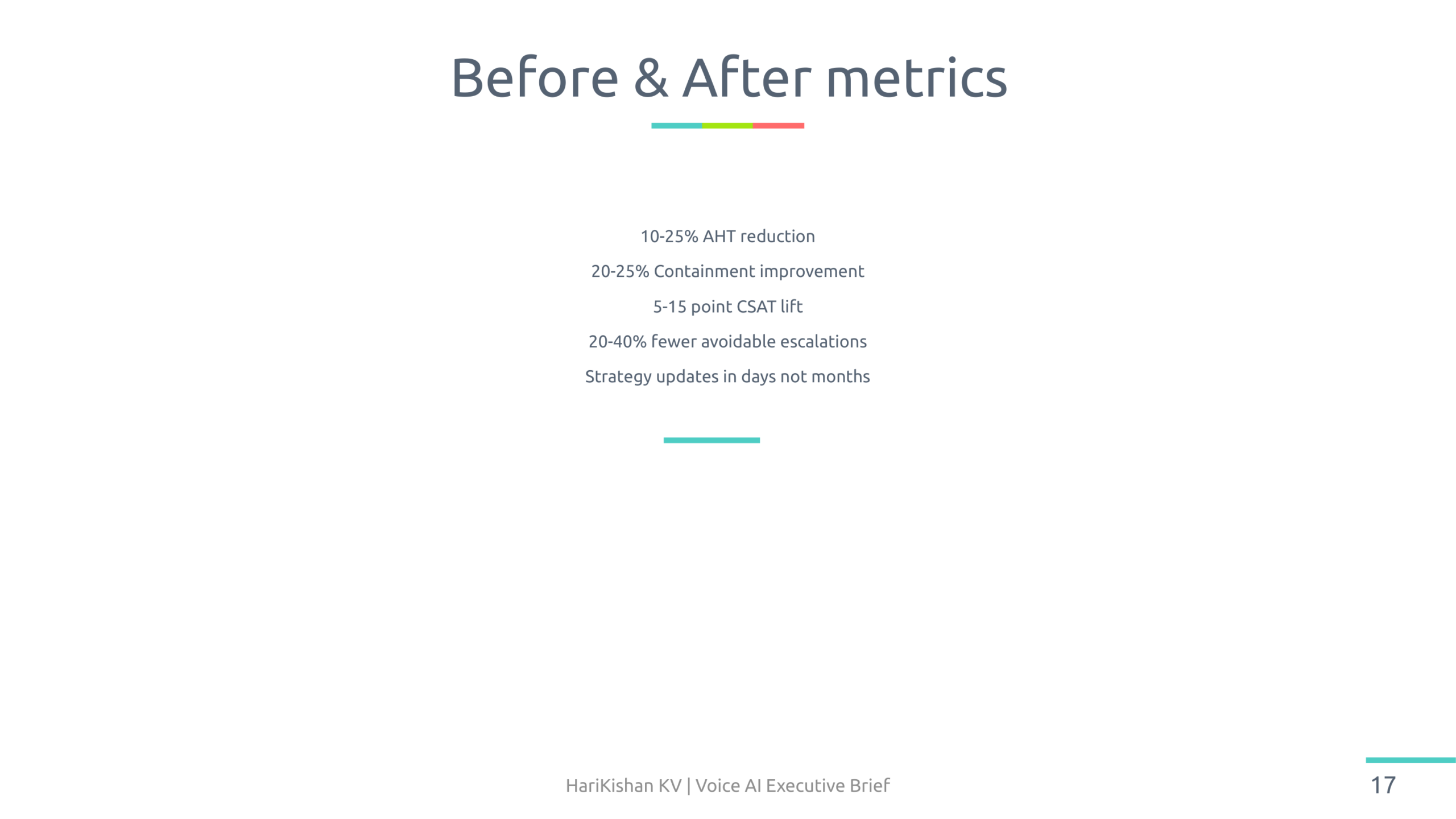
The session closed its first half on the numbers leaders actually ask for:
And the one executives repeat afterwards: strategy updates in days, not months.
Watch the session
The full talk is on the channel — press play below, or open it on YouTube and keep the tab open for the rest of the series.

Run this session at your event
Keynote, executive briefing or half-day workshop — the five eras, the architecture, and a closing that gives your audience something to build on Monday.
What this evolution actually asks of you
Three shifts were visible in the room, and none of them are technical:
IVR as infrastructure → Voice AI as an operating system
Voice stops being a cost center you tune and becomes the layer where brand, risk and trust meet.
Optimizing call flows → optimizing customer outcomes
A perfectly routed call that ends in frustration was never the goal. Route for the outcome, not the chart.
Release cycles → continuous adaptation
Behavior changes based on outcomes. The quarterly redesign stops being the unit of progress.
What does not work anymore
- Quarterly IVR redesigns — change velocity has moved to continuous, and your competitors’ assistants read the new policy the day it ships.
- Static containment targets — containment alone is no longer the score; ownership now sits where brand, risk and trust are decided.
- Treating voice like another digital channel — voice carries tone, hesitation and emotion. None of your web analytics prepare you for it.
These approaches scale effort, not outcomes.
What to do differently
- Design for adaptation, not completeness. Ship the smallest conversation that learns.
- Treat SSML as risk control, not just polish — pace and pause are how a system signals that it understood the weight of a question.
- Use agentic systems to learn continuously from what callers actually say.
- Govern decisions, not dialog trees. Dialog trees do not make consequential decisions. Agents do.
Slides and figures from VoiceAI Blueprints — Real-Time Voice Automation w/ RAG + Sentiment AI, presented at DSS Austin, February 2026. Ranges reflect the programs discussed in the session; the recording above is the full talk.
Bring this session to your audience
Keynotes, panels, executive briefings and half-day workshops on Voice AI, agentic architecture and real-time conversational systems — with the slides and the recording included.
Your customers stopped pressing 1. Has your strategy?
If your contact center is still shipping dialog trees while callers expect a conversation, let’s talk — the evolution is shorter than the gap you are carrying.
Book Hari to Speak